





Walk into any pharmacy or scroll any shopping app and you will find dozens of oils for a flaky, itchy scalp. If you have scalp psoriasis, choosing a scalp psoriasis oil can feel confusing: which ingredients matter, how much should you use, how long should it stay on, and how do you wash it out without making the scalp worse? This guide focuses on those practical questions so you can pick an oil carefully and use it well.

Shop the oil from this guide
Pay online (prepaid) and get 10% off.
Includes a free 12-week plan book with prepaid orders.
Why people use oil on scalp psoriasis
Scalp psoriasis often brings thick, dry scales and a tight, itchy feeling. Oils are popular because they help moisturise the skin and soften scales so they can loosen more easily. A softer, more comfortable scalp also makes it easier to wash and comb without scratching.
An oil is a support for daily scalp care. It does not replace a proper diagnosis or the care plan your doctor or dermatologist gives you.
How to choose a scalp psoriasis oil
Before you buy, turn the bottle around and read the label. Here is what to look for.
1. A short, clear ingredient list
The fewer ingredients, the easier it is to know what you are putting on sensitive skin and to spot anything you react to. Look for a product that clearly names its herbs and its base oil.
2. A familiar, gentle base oil
Coconut oil is one of the most common base oils for scalp care in India. It is familiar to most families and is widely used as a moisturiser for dry skin and hair.
3. Little or no added fragrance
Strong perfumes can irritate a sensitive scalp. If you are prone to reactions, choose a product without heavy added fragrance.
4. Clear usage and patch-test directions
A good product tells you how much to use, how long to leave it on, and how to patch-test first. If the directions are vague, ask the seller before using it on large areas.
5. Honest claims
Be careful of any product that promises instant or lifelong results. Psoriasis tends to come and go, and no oil can promise how your skin will respond.
A closer look at Psorease
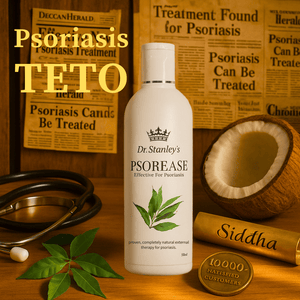
Dr. Stanley's Psorease TETO oil is a Siddha formulation from Thiruvananthapuram, Kerala. According to its product page, it uses just two ingredients: Wrightia tinctoria (called Vetpalai in Siddha) and coconut oil, prepared through a 14-day Surya Pudam process described in Siddha literature. It comes in a 500 ml bottle with directions for gentle application and a spot test.
How to use an oil on scalp psoriasis, step by step
Before the first use: spot test
Choose a small affected spot that is not easily visible. Apply the oil gently to that spot alone a few times a day for 2 to 3 days, leaving it on for at least four hours each time. If there is no redness, burning or itching, slowly extend to other areas. If you notice any reaction, stop.
Applying the oil
- Section your hair. Use a comb tail or your fingers to make partings about 2 cm apart so the oil reaches the scalp.
- Use a small amount. Pour a little onto your fingertips or into a small bowl. You can always add more.
- Dab, do not scrub. Press the oil gently onto the patches. Hard rubbing or massaging can irritate the skin.
- Top up as it absorbs. For Psorease, the directions say the oil usually absorbs in 30 to 45 minutes and can then be re-applied.
- Give it time. The Psorease directions suggest leaving it on the affected area for at least four hours. An evening application works well for many people.
Protecting your bedding
If you keep oil on overnight, wear a soft cotton cap or shower cap and use an old pillowcase or a towel over your pillow.
How to wash the oil out without irritating your scalp
This step is often rushed, but it matters just as much as the application.
- Loosen scales first. Once the scales have softened, gently run a wide-tooth comb through the area. Let loose flakes lift away on their own; do not pull at scales that are still stuck.
- Use lukewarm water. Hot water can dry out and irritate the scalp.
- Apply a mild shampoo to dry, oiled hair first. Working shampoo into the oil before adding water helps break it down, so you need less scrubbing.
- Rinse well. Leftover shampoo and oil can add to build-up.
- Pat dry. Press with a soft cotton towel instead of rubbing.
If your doctor has prescribed a medicated shampoo, ask them how to fit oiling around it.
Common mistakes to avoid
- Skipping the patch test because "it is natural".
- Using too much oil, which makes washing harder.
- Scratching or picking at scales while the oil is on.
- Applying oil to cracked, bleeding or oozing skin.
- Switching between many products every few days, which makes it hard to tell what suits you.
- Stopping a prescribed medicine on your own after starting an oil.
When to see a doctor
Please consult a qualified doctor or dermatologist if:
- You are not sure whether you have psoriasis, dandruff or a fungal infection.
- The scalp is bleeding, oozing, very painful or spreading quickly.
- You notice hair thinning in the affected areas.
- You have joint pain or swelling along with skin patches.
- You are pregnant or breastfeeding, or the oil is for a child.
Frequently asked questions
Is coconut oil alone enough for scalp psoriasis?
Plain coconut oil can help moisturise and soften scales, which is why many people use it. Herbal oils add plant ingredients to a base oil like coconut. Whichever you choose, patch-test first and keep your doctor informed.
Should I apply oil to wet or dry hair?
Apply it to a dry scalp. Oil spreads more evenly and stays on the skin better when the scalp is dry.
How often can I use a scalp psoriasis oil?
Many people use an oil daily as part of their routine. Follow the directions on the product you choose, and stop if your scalp feels more irritated.
Can I use the same oil on my elbows and knees?
Many scalp oils can also be used on other affected skin. Check the product's directions and patch-test each new area.
Is it okay to comb out the scales?
Only gently, and only once they are softened. Never force off scales that are still attached, as this can hurt the skin.
Start your routine today
Pay online (prepaid) and get 10% off.
Includes a free 12-week plan book with prepaid orders.
Important: This article is for general information only and is not medical advice. Please consult a qualified doctor or dermatologist about your skin condition, always patch-test any new product before regular use, and stop use if you notice irritation.